



Capturing your skiing or snowboarding footage usually means an action camera such as the ol’ GoPro or increasingly the Insta360 or DJI Osmo Action cams. But for a whole other angle on the action there are a growing number of compact drones, including some with hands-free operation.
I got hold of the DJI Neo 2 and took it to the mountains a couple of times this winter (as well as closer to home). So how does this drone stack up for your ski footage, is it a big upgrade vs the original Neo drone , and – most importantly – is it worth buying?
DJI Neo 2 vs DJI Neo
I’m a fan of the original DJI Neo, which is a pocket sized drone that can launch and be capturing footage in seconds instead of minutes. But there were always a stack of shortcomings that needed some addressing and that the DJI Neo 2 has definitely fixed.

Some of the improvements in the new drone include:
- 2 (two) axis gimbal offering better stabilisation
- 4k/60FPS video footage
- More and better hands free modes (including, as we shall see, Skiing follow)
- Larger onboard storage (up to 48gbs from 24gbs)
- Obstacle avoidance (a big one this…)
- Gesture controls (very cool)
- Better wind resistance
- Faster cruising and tracking speed
- Better control from the phone app
- Auto return to home (RTH) function without the controller
As you can see, thats a pretty long list and it’s not even everything. I haven’t mentioned better battery life as, honestly, I haven’t noticed it in the real world. But all of these add up to a really nifty hands free drone that very much justifies spending a bit more instead of going for the cheaper and older model.
But how is it on the slopes?
How good is the DJI Neo 2 for skiing/snowboarding?
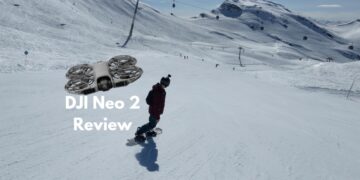
One of the best additions to the DJI Neo 2 is the new skiing follow mode. Designed to keep up with cruising skiers and snowboarders, its a huge improvement to the original ‘follow mode’ on the old DJI Neo which was a little sluggish and could easily fall behind.
You can now safely cruise down the mountain confident that your drone is more than likely keeping pace with you. The operational word there is ‘cruise’ as I don’t think this would keep up if you straightlined it as fast as you can go. Apparently the Neo 2 will keep pace up until around 40-45km per hour, which is pretty quick.
If you’re controlling the drone from an FPV controller or the RC-N3 remote then it can even go up to 100 km/per hour. As you’ll see from my video below, I didn’t put it through it’s paces at maximum speed (mainly because it was new and I’d had issues with the original one getting lost) – but it captured some great footage of me from behind.
Being able to move the drone’s tracking position is also a very cool option. You don’t necessarily have to keep it behind you, by using gesture controls you can bring the drone closer to you or further back, position it to the side or in front of you or bring it back to your palm.
It’s a lot of fun to just pull the drone out and capture some landscape footage, or quickly capture a bit of cruising footage. I think it would be especially good if you were doing a powder run or some park footage.
For off-piste and tree runs, it could also be a great toy. The obstacle avoidance means that you’re less likely to lose it from a collision vs the original Neo – but that is still a risk.
The shooting modes
One of the cool things about the Neo series of drones is the quick launch pre-set shooting modes. These allow you to cycle through the modes on the drone itself, launch and capture footage entirely hands free – which is obviously a great idea when skiing or snowboarding.
Beyond the new skiing follow mode, the DJI Neo 2 comes with a bunch more presets and more customisation options. These include:
- Master Shots – the Neo 2 launches and captures a montage of you (in one place) within about a minute.
- Helix/Boomerang – two new modes that rotate around the subject in a spiral.
- Cycle follow – similar to skiing follow (of course).
- Dolly Zoom – a really cool new shooting mode which captures a cinematic zoom out/dolly in shot. Great for mountain backgrounds.
As mentioned, the new gesture control is also a great touch. This works on the tracking modes, allowing you to reposition the drone on the fly. You can also use voice control through your phone, and manage the drone through Apple Watch…
Some things to note
As you can probably tell, I think the Neo 2 (and to an extent the original Neo) are well worth buying if you’re looking for some unique footage. If thats for casual holiday footage, sharing on socials or a bit of vlogging, the compact and easy to use nature of the Neo 2 make it very appealing. And it’s also very affordable which could be a big factor for many.
There are a few things that need to be kept in mind though, to ensure you don’t lose your fairly costly new piece of kit…
First up wind resistance. While the DJI Neo 2 does offer significantly better wind resistance vs the original Neo, high winds and changeable mountain conditions can be a hazard. My original Neo flew away on a windy day by the sea (I did get it back eventually but a lesson was learned) and I’d be wary of high altitude gusts.
With that being said, the Neo2 can withstand winds of up to 38 km/per hour which is, to be fair, quite strong and about 10 km/hr more than the original Neo.
The battery life is also not the most amazing. Flying at low altitude and in low winds I’ve managed to get my drone to fly about 1 km from me before a notification comes up telling me I need to come back. One battery lasts about 19 minutes, according to the manufacturer, and I’d say thats probably accurate. You will need multiple batteries if you want to capture more than just a handful of shots.
Another thing to mention is that if you buy the drone first and then buy the controller later, you’ll need to remember to buy the transceiver too. The original Neo just plugged into the controller and then you were good to go, but the Neo2 needs a whole extra widget to function with the RC unit. If you buy the whole ‘fly more combo’ kit then you’ll get this included, plus extra batteries, so that’ll be fine – but just to keep in mind.
The Neo2 is also a little bigger than the original Neo drone. This means you’ll probably need a case and/or a day pack to carry it out onto the mountains and protect it. The original Neo fit easily inside my ski jacket pocket which was ideal, but this one is a bit bulkier. It’s still a great size, and very discreet, but check its size before you make plans to go shoot on the hill with it.
I have seen also from online groups (on Reddit mostly) that some people have seen their drone fly away or disconnect from their devices and then lose them. If you’re worried about possibly losing your drone, make sure to buy the drone protect insurance from DJI. This means they’ll either replace at a discount or repair drones that are damaged or lost in the first year of ownership.
Should you buy the DJI Neo 2?
If you’re looking for a fun, affordable and easy to control drone to capture ski or snowboard footage and other travel shots then the answer is a sold yes. I am a big fan of the Neo series of drones and, as you’ll see from my videos, I use them quite a bit.
This is very much a drone designed for casual users with a pretty shallow learning curve. You can easily control the drone from your phone, no need for the controller. There are a bunch of really good preset modes which mean you can launch and shoot without really ever needing the controller, which is definitely more of an essential for the original Neo.
Read more: Best ski follow drones.