




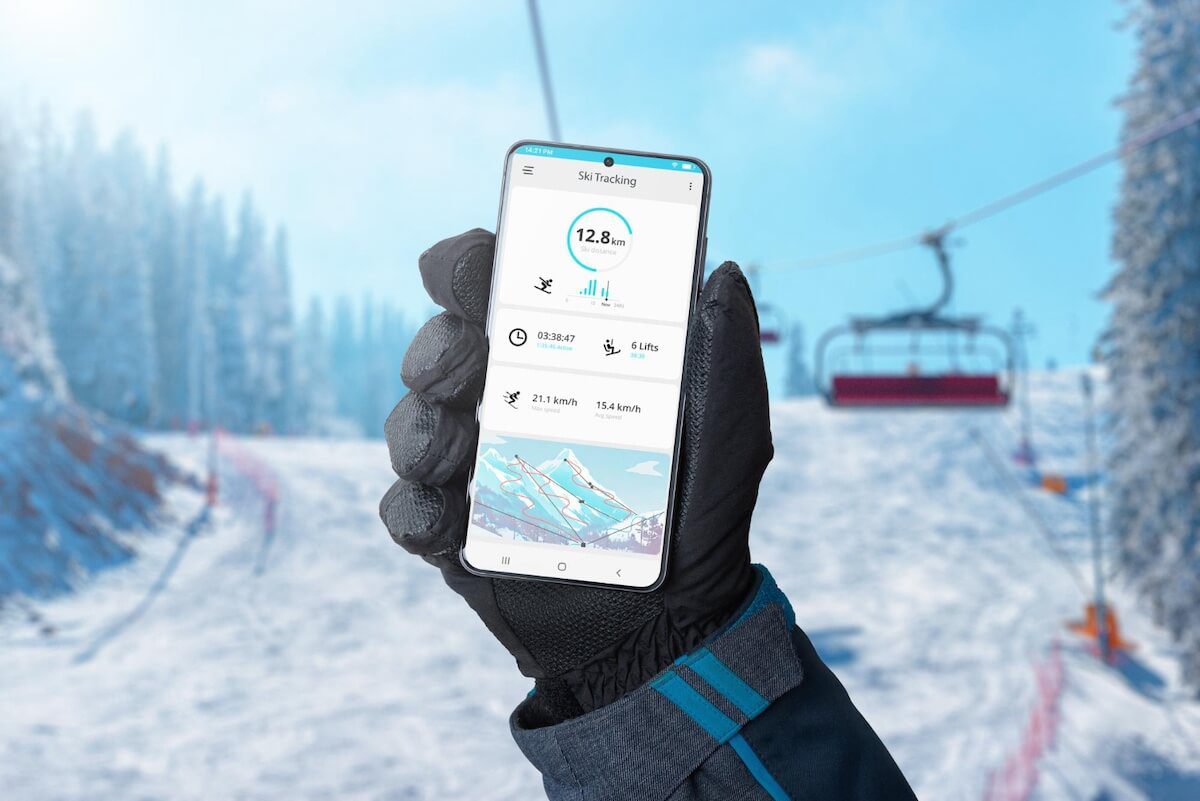
The smartphone has quietly become as essential to the modern skier’s kit as a good pair of ski goggles. When used correctly, it’s not a distraction from the mountain environment, but a tool to enhance it. In fact, the right software turns the device in your pocket into a personal meteorologist, a performance tracker, a navigational aid, and even a digital coach.
While the app stores are cluttered with winter sports applications, many of which drain battery life faster than a cold chairlift ride without offering much utility. We have tested the field to identify the most functional, reliable apps that genuinely add value to your time on the snow for the coming winter season.
Here are our pick of the essential apps for skiers and snowboarders this winter.

Slopes
For years, tracking apps required manual pausing at the bottom of every run to avoid skewing data. Slopes solved this with excellent automated detection, understanding when you are actively skiing versus riding a lift or standing in a queue. You simply hit record at the start of the day and put your phone away.
The interface is clean and modern, providing a detailed end-of-day summary including vertical drop, top speed, and run counts. Particularly engaging is the interactive 3D map, which allows you to replay your day’s route. For those who enjoy friendly competition, private leaderboards let you compare stats with friends who were on the mountain with you, without broadcasting your location to the wider public.
Price: The free version is robust, offering unlimited tracking and daily summaries without ads. The Premium subscription (~$29.99/£25 annually) unlocks real-time run-by-run stats, richer 3D mapping features, and Apple Watch health integration.
OpenSnow
If your skiing decisions are dictated by falling snow (I mean, of course they are), OpenSnow is indispensable. While general weather apps provide broad data, OpenSnow employs local meteorologists to interpret complex weather models for specific ski regions.
Their “Daily Snow” written forecasts explain not just how much it might snow, but the quality of that snow, timing, and wind factors. For serious powder chasers, this human insight is far more valuable than raw automated data. The app also features high-quality snow stake webcams and 10-day trend maps to help plan trips further out.
Price: While a very basic version exists, the core functionality – expert forecasts and 10-day outlooks – requires an All-Access subscription, typically ranging between $30 and $50 annually.
Carv
Carv addresses the difficulty of receiving consistent, objective feedback on skiing technique once you move past beginner lessons. It is a hardware-and-software system designed to act as a digital coach. A sensor unit clips onto your ski boot and analyzes pressure, edging angles, and balance in real-time as you ski – so this is more than an app to be fully honest.
Through headphones, Carv provides immediate audio feedback, such as “apply more pressure to your outside ski early in the turn”, and gamifies improvement with a “Ski:IQ” score. It is an investment, but for intermediate or advanced skiers who’ve hit a plateau, it offers a level of data analysis that even a human instructor cannot see with the naked eye.
Price: The hardware sensor unit costs approximately $249/£199. A recurring membership for the app’s data analysis is also required, usually around $100–$150 per year.
Strava (featuring FATMAP)
For those venturing off-piste or exploring vast resort terrain, high-quality mapping is a safety imperative. The premier 3D winter mapping platform, FATMAP, has been acquired and integrated into Strava.
Within the Strava app, skiers can now access high-resolution 3D maps that are crucial for scouting lines. The ability to overlay gradient layers to identify slope angles is a vital tool for avalanche terrain avoidance and route planning. While Strava is known for fitness tracking, its value here is as a powerful navigational utility for the adventurous skier.
Price: Basic tracking is free. Accessing the detailed 3D winter maps and advanced route planning tools requires a Strava subscription (~$80/£55 annually).
Ski Tracks
If Slopes is the modern, feature-rich tracker, Ski Tracks is the reliable workhorse. It has been a staple for years due to its efficiency; it is designed to record an entire day on the mountain with minimal impact on battery life, and crucially, it requires no data signal to operate.
It lacks the polished social features and slick 3D replays of competitors, but it provides excellent, raw technical data, including detailed graphs of speed, altitude, and slope degree. For the skier who simply wants a reliable log of their stats without bells and whistles, it remains a top choice.
Price: A one-time purchase of approximately $1.99/£1.99.
OnTheSnow
While OpenSnow predicts what will happen, OnTheSnow is excellent for verifying what is happening. This app aggregates official snow reports and open trail data for over 2,000 resorts globally.
Its greatest strength lies in its user-generated content. By viewing recent photos uploaded by other skiers at the resort that day, you can gauge real-time visibility and surface conditions better than an official marketing report might indicate. It is the best free tool for a quick morning check of resort webcams and overnight snowfall totals.
Price: Free.
PeakFinder
Ever stood on the mountain trying to work out what that mountain is called. Well, this app serves a singular, satisfying purpose. When standing at a summit and looking out at a sea of unidentified mountains, PeakFinder provides the answers.
Using augmented reality, you point your camera at the horizon, and the app overlays the names and elevations of every visible peak. It works completely offline, making it a great companion for scenic chairlift rides in unfamiliar ranges. And you don’t get charged roaming data too, which is nice.
Price: A one-time purchase of approximately $4.99/£4.99.
CheckYeti
Booking instruction in Europe can often involve navigating fragmented local ski school websites. CheckYeti acts as an aggregator, streamlining the process of finding and booking certified instructors and guides.
It covers over 500 resorts, primarily in the Alps, allowing you to compare prices, read reviews of specific schools, and secure bookings instantly. It is particularly useful during peak season when availability is scarce.
Price: The app is free to use; you pay the standard rate for the lessons booked.
Heading to the mountains this winter?
We hope you’ve enjoyed this run down of the essential ski apps out there on the market. If you’re planning a trip this winter, hopefully these will tick those boxes for you.
Looking for some ski resort inspiration? Get our handy (spam free) newsletter by signing up below. We regularly share deals, reviews, season updates and much more…